
When Caring Starts to Cost Too Much
A nurse can still love nursing and feel changed by what the work has required her to carry. She can remain compassionate, clinically capable, and deeply committed to her patients, even as she notices that something inside her no longer resets as easily as it once did.
Compassion fatigue doesn’t always announce itself through a dramatic breakdown. More often, it slips quietly into ordinary life. The nurse becomes more irritable, emotionally detached, or easily overwhelmed. A patient’s story follows her home. Sleep happens, but restoration doesn’t. Small decisions require more energy than they should, and the patience she once offered freely begins to feel as though it’s being drawn from an account that no longer has time to refill.
From the outside, she may still appear to be functioning well. She completes the assessment, responds to the emergency, comforts the family, helps a coworker, finishes the documentation, and returns for the next shift. Inside, however, caring is beginning to cost more than she can consistently replace.
The Shift Can End Before the Experience Does
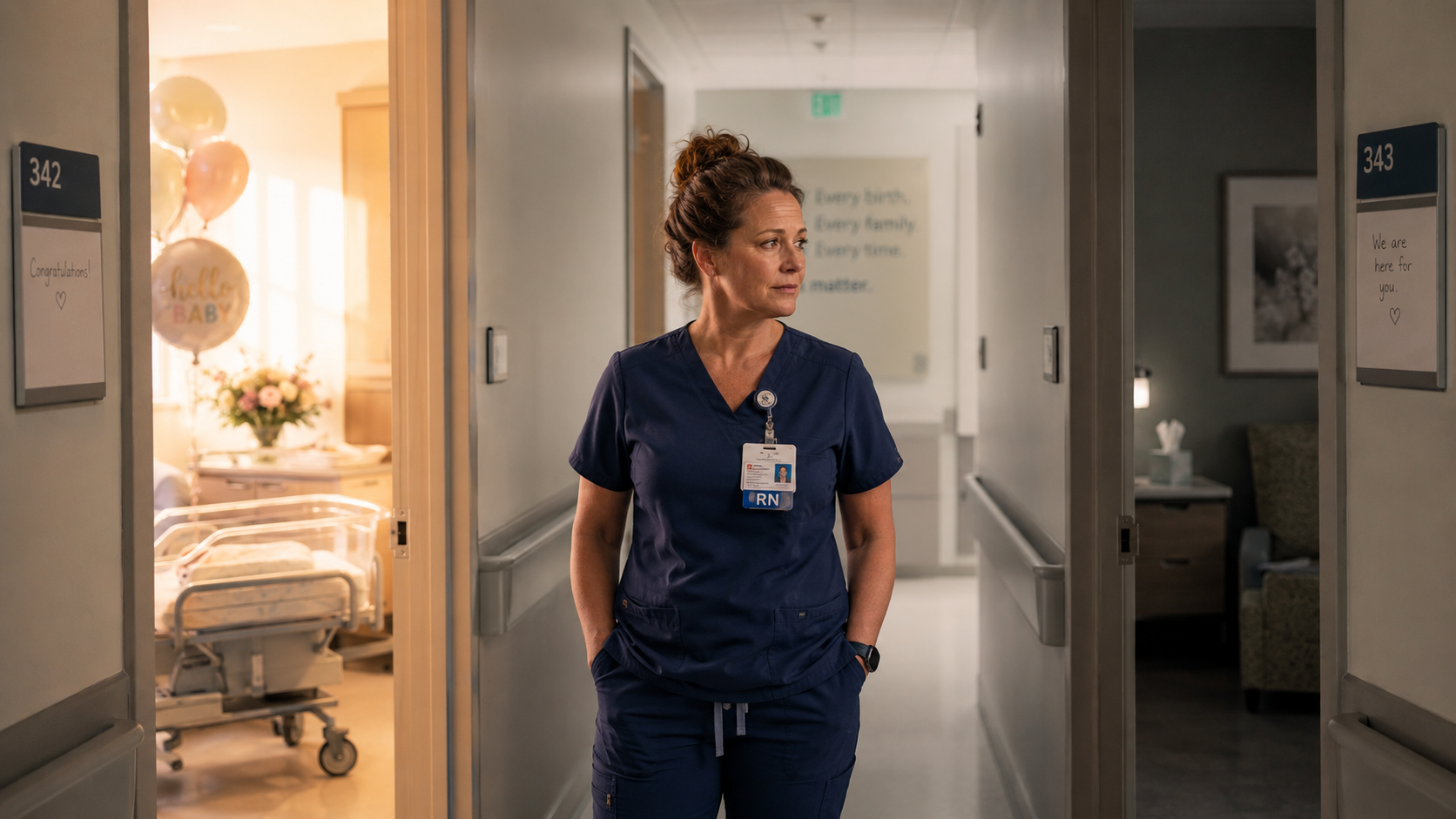
After more than 20 years in obstetric nursing, I know how a shift can end on paper while part of it continues traveling home with you. The chart may be closed, report may be given, and the badge may be removed, but the body and mind don’t always understand that the emergency is over.
It may be a delivery that changed without warning, a maternal emergency, a pregnancy or neonatal loss, a frightened patient, or a family trying to absorb news they never expected to hear. Sometimes it isn’t one dramatic event at all. It’s the accumulated emotional weight of repeatedly being present for people during the most vulnerable moments of their lives.
Obstetric nurses can move from one emotional extreme to another within minutes. One room may be filled with celebration, while another holds fear, trauma, grief, or uncertainty. The nurse is expected to enter each space ready to provide what that patient and family need, even when she hasn’t had time to process what happened in the room she just left.
The ability to make that transition is a professional strength. Nurses learn to focus, compartmentalize, and remain steady because someone needs them to be steady. The problem begins when compartmentalization becomes the only available coping mechanism, and everything placed in those mental compartments continues to accumulate.
Compassion Fatigue Doesn’t Mean Compassion Has Failed
Burnout and compassion fatigue can overlap, but they aren’t always driven by the same pressures. Burnout is commonly associated with prolonged workplace stress, including chronic understaffing, excessive workload, administrative burden, limited resources, unpredictable schedules, and a lack of control over working conditions.
Compassion fatigue is more closely associated with repeated exposure to suffering, fear, grief, trauma, and the emotional needs of the people receiving care. It may become attached to a particular patient, event, or outcome, even when the nurse still finds meaning in nursing and continues to care deeply about the people she serves.
Many nurses are carrying both. They’re emotionally affected by what they have witnessed while also trying to function within systems that don’t provide enough time, staffing, support, or recovery between difficult experiences.
A 2025 systematic review and meta-analysis included 15 studies involving 6,799 obstetric and gynecologic nurses. The researchers estimated that 77.6% experienced moderate-to-severe compassion fatigue. The included studies varied substantially, so that percentage shouldn’t be treated as a universal rate for all nurses or OB units. It does, however, reinforce that compassion fatigue is not a rare or isolated experience among nurses working in these areas.
Compassion fatigue isn’t evidence that a nurse is weak, unprepared, uncaring, or no longer suited for the profession. It’s a sign that repeated emotional exposure and inadequate recovery may be affecting her ability to continue carrying the work in the same way.
The System Cannot Treat Compassion as an Unlimited Resource
Healthcare depends on nurses being clinically observant, emotionally present, responsive, patient, and compassionate. Yet nurses are sometimes treated as though that capacity renews automatically at the start of every shift, regardless of what happened during the previous one.
It doesn’t.
The National Institute for Occupational Safety and Health identifies long and unpredictable hours, heavy administrative burden, limited control over schedules, demanding physical work, and repeated exposure to suffering and death among the stressors affecting healthcare workers. NIOSH has also emphasized, through its Impact Wellbeing campaign, that meaningful improvement requires changes to working conditions rather than placing the full responsibility for coping on individual workers.
That distinction matters because personal self-care cannot repair unsafe staffing, ineffective leadership, workplace violence, excessive workload, or a culture that discourages nurses from asking for support. A breathing exercise cannot create another nurse for an unsafe assignment. A gratitude journal cannot replace a meaningful debrief after a traumatic event. A wellness challenge cannot compensate for a workplace that repeatedly asks nurses to absorb more than any person can sustainably carry.
Self-care shouldn’t become a convenient way for organizations to avoid responsibility. Healthcare leaders remain responsible for creating safer workloads, providing psychological support, protecting nurses from violence, responding appropriately to concerns, and developing cultures where asking for help isn’t interpreted as weakness. (I wrote more about this in Nurses Deserve More Than One Week of Recognition.)
At the same time, waiting for every systemic problem to be corrected can leave an individual nurse unprotected today. The system must do better, and nurses still need practical tools that help them recognize what’s happening, protect their remaining capacity, and seek support before complete depletion becomes the only thing powerful enough to force them to stop.
Both truths can exist together.
Notice the Pattern Before You Normalize It
Compassion fatigue doesn’t always arrive as a complete emotional collapse. More often, its early signs are gradually absorbed into the nurse’s definition of normal.
A nurse may notice that she has become more irritable at work or at home. She may feel unusually detached from patients, emotionally numb during situations that once affected her deeply, or more reactive to small stressors. Concentration may become harder, sleep may feel less restorative, and the thought of returning to work may produce a level of dread that wasn’t there before.
She may begin withdrawing from coworkers because explaining how she feels requires too much energy. She may replay a patient encounter repeatedly, carry guilt over an outcome she couldn’t control, or feel as though her body remains tense long after she has left the hospital.
One difficult shift or one exhausting week doesn’t automatically mean a nurse is experiencing compassion fatigue. The concern is the pattern. The warning sign is when emotional depletion becomes so familiar that it feels like an unavoidable part of the profession.
Nurses are often skilled at identifying changes in other people. We notice subtle differences in behavior, breathing, speech, skin color, pain, or responsiveness because we know that pattern matters. We need to apply some of that same awareness to ourselves.
The questions may be simple: Am I more irritable, detached, or emotionally reactive than I used to be? Is there a patient or event I can’t mentally release? Is my concentration changing? Do I still care deeply but feel that caring is taking more than I can replenish?
Awareness isn’t self-diagnosis. It’s an opportunity to respond earlier.

Ask What You’re Actually Carrying
One of the most useful questions a nurse can ask after a difficult shift is, “What am I carrying from today?”
The answer may be emotional exposure to a traumatic outcome. It may be moral distress from knowing what a patient needed while lacking the resources or authority to provide it. It may be anger about unsafe staffing, worry about a clinical decision, grief for a family, or the accumulation of several smaller pressures that have been building for weeks.
Once the source is named, the next questions become clearer. What belongs to me, and what belongs to the situation? What belongs to the organization? What requires rest? What requires a boundary? What needs to be discussed with a trusted colleague, leader, counselor, or other support person?
Not everything should be processed alone, and not everything can be resolved through personal self-care. A nurse shouldn’t interpret every form of exhaustion as a personal failure to cope. Sometimes the problem is that she has witnessed something painful. Sometimes she has worked too many hours without adequate recovery. Sometimes she has repeatedly raised a concern and hasn’t been heard. Often, several of these factors are operating at the same time.
Naming the source of the strain helps the nurse choose a response that fits the actual problem rather than applying the same generic wellness advice to every form of distress.
The Old Human Rules Still Apply
Long before self-care became an industry, people recovered from difficult experiences through rest, nourishment, movement, reflection, community, meaningful rituals, and conversation with trusted people. Healthcare has become more technically advanced, but the human nervous system hasn’t become infinite.
Nurses still need time to process what they have witnessed. They need relationships where they can speak honestly without having to explain why the work affected them. They need boundaries between the hospital and home, even when those boundaries are imperfect. They need sleep, hydration, food, movement, laughter, quiet, fresh air, and periods when they aren’t responsible for keeping everyone else steady.
These practices don’t have to be elaborate. In fact, the most useful forms of self-care are often the ones realistic enough to repeat. A short transition ritual after work, a few minutes spent identifying what’s still being carried, a conversation with someone who understands, or a clear boundary around one additional responsibility may be more protective than an occasional grand gesture.
Self-care works best when it becomes a pattern of noticing and responding rather than an emergency measure used only after everything has become unbearable.
The Goal Isn’t to Tolerate the Intolerable
Self-care should never be used to train nurses to endure increasingly harmful working conditions with a better attitude. Its purpose isn’t to make nurses more efficient at absorbing impossible demands.
The goal is earlier recognition. It’s noticing when sleep, patience, concentration, relationships, physical tension, or connection to the work begins to change. It’s understanding that these changes are information, not evidence of personal inadequacy.
Self-care may help a nurse maintain enough clarity to communicate her needs, seek appropriate support, establish boundaries, and protect the parts of herself that exist beyond her profession. It may help her identify when ordinary recovery strategies are no longer enough, and additional professional support is needed.
Nurses don’t need another lecture telling them to take a bubble bath, think positively, or manage their time better. They need language for what they’re experiencing and realistic strategies that fit the demands of nursing life. They need permission to protect their capacity before there is nothing left to protect.
Caring for Yourself Protects More Than Your Career
Nurses are not separate from the care they provide. Their physical, emotional, and cognitive well-being affects how they communicate, make decisions, notice changes, interact with coworkers, and remain present with patients and families.
That doesn’t mean nurses are responsible for maintaining perfect wellness in broken systems. It means their well-being belongs in the conversation about safe, sustainable healthcare.
Protecting the nurse protects the person beneath the title. It protects her relationships, health, judgment, sense of purpose, and ability to remain connected to work that may still matter deeply to her. It also challenges the idea that a good nurse should continue giving until nothing remains.
A nurse can remain compassionate without offering every last piece of herself.
From Recognition to Action
This is why I created OB Nurse Self-Care: Preventing Compassion Fatigue. The one-hour continuing education course was designed for OB and perinatal nurses working in settings where joy, urgency, trauma, uncertainty, and grief can coexist within the same shift.
The course helps nurses distinguish compassion fatigue from burnout, recognize emotional, physical, cognitive, and behavioral warning signs, and apply realistic approaches to self-regulation, communication, boundaries, peer support, and recovery. It isn’t designed to add more work to an already full plate. It’s designed to help nurses understand what they’re carrying and respond before survival mode becomes their permanent setting.
The course is $39 and provides one continuing education contact hour. A complimentary compassion fatigue guide is also available through the course page.
Explore OB Nurse Self-Care: Preventing Compassion Fatigue and access the complimentary guide through the Continuing Education page.
Knowing without doing is not knowing.