
Maternal Sepsis in OB: 5 Clinical Clues Nurses Should Never Miss
Maternal sepsis does not always begin with the patient everyone immediately recognizes as critically ill. Sometimes it begins with a heart rate that has been slowly climbing throughout the shift, worsening pain, chills, unusual fatigue, or a patient who simply says she does not feel right. Her blood pressure may be lower than it was earlier without appearing dramatically abnormal, and her temperature may not even be elevated.
The challenge for the OB nurse is that each of those findings may have a reasonable explanation when considered separately. She just delivered. She has been awake all night. She is in pain. She lost blood. She is anxious. Pregnancy itself affects heart rate, blood pressure, respiratory physiology, and laboratory values. The concern begins when those explanations no longer account for the whole clinical picture.
Maternal sepsis is a life-threatening condition involving organ dysfunction caused by infection during pregnancy, childbirth, or the postpartum period. The Alliance for Innovation on Maternal Health (AIM) uses the World Health Organization definition of maternal sepsis and includes the postpartum period through 42 days after pregnancy.
Maternal sepsis remains an important maternal safety concern. A 2025 systematic review and meta-analysis of 44 studies and more than 141 million pregnancies estimated a pooled global maternal sepsis incidence of approximately 13.16 cases per 10,000 pregnancies, although incidence varied considerably by region and study design.
For OB nurses, knowing the definition is only the beginning. The more important bedside question is whether we can recognize when several subtle findings are starting to form a concerning pattern. Understanding where maternal sepsis begins, how pregnancy can change its presentation, and what deserves further assessment can help nurses recognize deterioration earlier.
Here are five clinical clues every OB nurse needs to know.
1. The Cause of Maternal Sepsis Often Depends on When It Occurs
No single infection causes maternal sepsis. The most likely source can change depending on whether the patient is antepartum, intrapartum, or postpartum, so the timing of the illness is an important part of the nursing assessment.

During pregnancy, genitourinary infections are an important source of maternal infection and sepsis. Pyelonephritis is one of the more serious infections encountered during the antepartum period. A pregnant patient who develops flank pain, fever or chills, nausea, vomiting, urinary symptoms, costovertebral-angle tenderness, or abnormal urinalysis findings may require further evaluation for pyelonephritis, particularly when those findings are accompanied by changes in the patient’s overall condition.
The American College of Obstetricians and Gynecologists notes that pyelonephritis during pregnancy can lead to serious maternal complications, including sepsis, septic shock, acute renal insufficiency, and acute respiratory distress syndrome. This is one reason urinary complaints during pregnancy should not be viewed only as isolated discomforts when the rest of the clinical picture is also changing.
During labor, intraamniotic infection is another important source to consider. Historically referred to as chorioamnionitis, intraamniotic infection may be associated with maternal fever, maternal or fetal tachycardia, uterine tenderness, and other clinical signs of infection. The patient’s presentation, risk factors, membrane status, and symptom progression all contribute to the assessment.
After delivery, the potential sources of maternal sepsis expand further. Endometritis or endomyometritis, cesarean surgical-site infections, urinary tract infections, pyelonephritis, retained products of conception complicated by infection, mastitis, pneumonia, wound infections, soft-tissue infections, and intra-abdominal infections may all contribute to maternal deterioration.
The important bedside point is that maternal sepsis is not synonymous with uterine infection. OB nurses naturally focus on pregnancy-related and reproductive causes, but infection can originate almost anywhere in the body. When a pregnant or postpartum patient begins to deteriorate, the clinical question needs to extend beyond the uterus to consider where else infection may be developing.
2. Maternal Sepsis May Begin With an Obstetric or Non-Obstetric Infection
Working in obstetrics teaches us to think obstetrically, and in many situations that serves our patients well. A postpartum patient with fever, uterine tenderness, and abnormal lochia immediately raises concern for a pelvic infection. A laboring patient with prolonged rupture of membranes, fever, uterine tenderness, or fetal tachycardia appropriately triggers consideration of intraamniotic infection.
More difficult cases may involve patients whose infections do not initially look obstetric. Maternal sepsis can develop from respiratory, urinary, gastrointestinal, skin, soft-tissue, surgical, or other infections just as it can in a patient who is not pregnant.
A postpartum patient presenting with shortness of breath and tachycardia may appropriately raise concern for pulmonary embolism, particularly because pregnancy and the postpartum period increase thromboembolic risk. Those findings can also occur with pneumonia, infection, and sepsis. The goal is not to choose a diagnosis prematurely, but to recognize that a changing maternal condition may require a broader differential diagnosis.
The same is true for symptoms that can easily be attributed to pregnancy. Back pain may be musculoskeletal, but it can also accompany pyelonephritis. Abdominal discomfort may relate to pregnancy, labor, surgery, or normal postpartum recovery, but worsening or changing pain in combination with systemic findings deserves a second look.
Clinical reasoning becomes especially important when the original explanation no longer fits what the nurse is seeing. If the patient continues to deteriorate despite what initially appeared to be a reasonable explanation, infection should remain part of the differential.
3. Maternal Sepsis Does Not Require a Fever
One of the most important points for nurses to remember is that maternal sepsis can occur without fever. Fever can be an important indicator of infection, but the absence of an elevated temperature does not rule out sepsis in a pregnant or postpartum patient.
The Society for Maternal-Fetal Medicine recommends considering sepsis in pregnant or postpartum patients with suspected or confirmed infection and otherwise unexplained organ dysfunction regardless of whether fever is present. SMFM Consult Series #67, which was reaffirmed in 2025 and is endorsed by ACOG, emphasizes that sepsis and septic shock during pregnancy are medical emergencies requiring timely recognition and treatment.
AIM makes a similar recommendation in its Sepsis in Obstetric Care Patient Safety Bundle. Clinicians are encouraged to consider sepsis when a pregnant or postpartum patient’s condition is deteriorating, even when fever is absent.
This matters because a normal temperature can become falsely reassuring. If the nurse’s thought process becomes, “She does not have a fever, so this probably is not sepsis,” other changes may receive less attention than they deserve.
Instead, maternal assessment should include the complete pattern. Changes in heart rate, respiratory rate, work of breathing, blood pressure, oxygenation, mental status, urine output, perfusion, pain, functional ability, laboratory findings, and overall clinical appearance may all contribute valuable information.
None of those findings independently proves that a patient has maternal sepsis. Concern increases when several findings change together in a patient with a known or suspected infection, or when deterioration cannot be explained otherwise.
4. Normal Pregnancy Physiology Can Blur the Early Warning Signs
Maternal sepsis can be particularly difficult to recognize because some of the physiologic changes used to identify deterioration in the general adult population also occur normally during pregnancy. Maternal heart rate increases as pregnancy progresses; blood pressure may decrease; white blood cell counts may rise; and respiratory physiology changes. Labor and the immediate postpartum period can further alter these values.
Research examining maternal sepsis recognition has repeatedly identified this physiologic overlap as an important challenge. A vital sign that would appear clearly abnormal in another adult may be less straightforward in the obstetric patient, making clinical context and trends especially important.
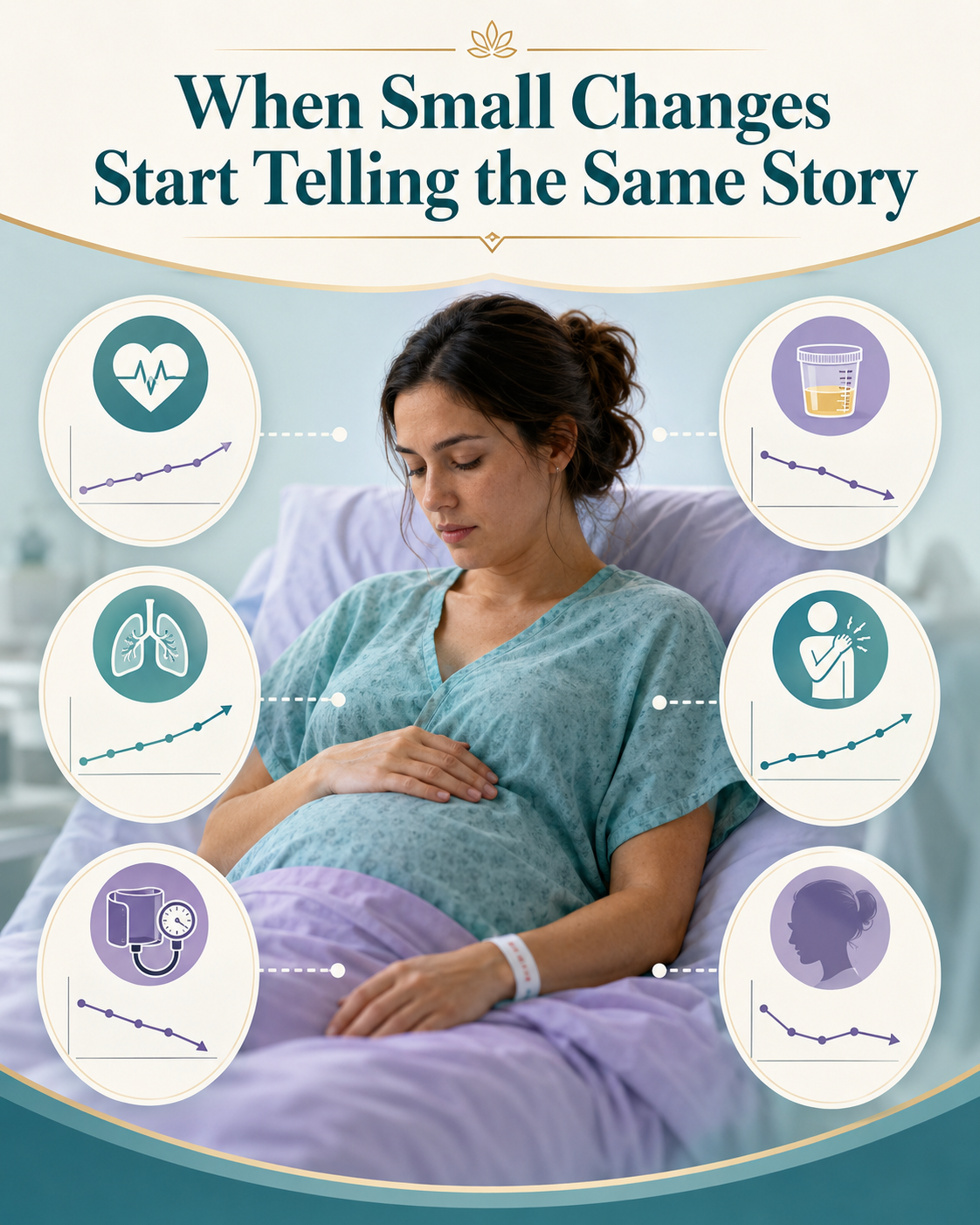
Consider two patients who both have a heart rate of 112 beats per minute. One has consistently remained between 105 and 115, is comfortable, normotensive, breathing normally, voiding adequately, and has no evidence of infection. The second patient had a heart rate of 82 four hours earlier, which then increased to 96, 104, and finally 112. She is also reporting worsening abdominal pain and chills; her respiratory rate has increased; her urine output has decreased; and her blood pressure is trending downward.
The number is identical, but the clinical picture is not.
This is where nursing surveillance becomes particularly valuable. Nurses see the patient over time. We know what she looked like earlier in the shift, what symptoms were present then, what has changed, and which findings are beginning to move in the wrong direction.
Maternal sepsis recognition is therefore not simply about identifying one dramatically abnormal value. It often requires recognizing a trend, placing it within the patient’s clinical context, and noticing when several seemingly minor findings begin to tell the same story.
5. Recognizing Maternal Sepsis Is Only the First Step
Recognition matters, but what happens next matters just as much. When maternal sepsis becomes a concern, nursing assessment needs to move toward focused reassessment, communication, escalation, and treatment according to the patient’s condition and the facility’s established protocols.
SMFM identifies maternal sepsis and septic shock as medical emergencies that require immediate treatment and resuscitation. Current guidance recommends evaluating potential infectious and noninfectious causes of organ dysfunction; obtaining appropriate cultures when doing so, without substantially delaying antibiotic administration; measuring serum lactate; identifying the suspected source of infection; and pursuing source control when indicated.
For patients with septic shock or a high likelihood of sepsis, SMFM recommends empiric broad-spectrum antimicrobial therapy ideally within one hour of recognition. This does not mean the bedside nurse independently diagnoses or treats sepsis. It does mean that early nursing recognition, clear communication, and timely escalation can influence how quickly the rest of the clinical response begins.
Depending on the situation and facility protocol, the nurse may repeat and trend vital signs, perform a focused reassessment, evaluate mental status and perfusion, monitor urine output, review available laboratory findings, activate a maternal early-warning or sepsis pathway when indicated, establish or maintain appropriate IV access, obtain ordered cultures and laboratory studies, prepare for prescribed antimicrobial and fluid therapy, and continue reassessing the patient’s response.
Fetal assessment may also be needed depending on gestational age and the clinical circumstances. Throughout the response, communication remains critical because a changing maternal condition may require repeated updates rather than a single notification.
Screening tools and early-warning systems can support this process, but they should not replace nursing judgment. SMFM recommends that healthcare systems develop procedures for identifying maternal sepsis while avoiding reliance on one screening tool alone. AIM similarly recommends obstetric-specific assessment criteria, standardized response processes, multidisciplinary education, and systems that support escalation across settings.
That last point matters because maternal sepsis does not occur only in labor and delivery. A postpartum patient may present to an emergency department. A pregnant patient may first seek care in urgent care or a physician’s office. Another patient may deteriorate on a medical-surgical unit or in an intensive care setting. Anyone caring for pregnant or recently pregnant patients needs to understand that maternal sepsis can present outside the traditional OB unit.
What Are OB Nurses Most Likely to Miss About Maternal Sepsis?
The most easily missed part of maternal sepsis may not be a particular vital sign or laboratory result. It may be the tendency to explain each finding independently rather than stepping back to reconsider the entire clinical picture.
A patient’s tachycardia may initially seem related to pain. Her fatigue may seem expected after delivery. Her white blood cell count may be elevated due to recent labor. Her blood pressure may still fall within an acceptable range. Her temperature may be normal. Each explanation can sound reasonable on its own.
The more important question is whether those explanations still make sense when they are viewed together.
This is where clinical pattern recognition becomes central to maternal safety. The nurse does not need to label every mild abnormality as sepsis, nor should every elevated heart rate automatically trigger an emergency response. The goal is to recognize when several subtle changes are no longer behaving like isolated findings.
AIM emphasizes early identification and treatment of infection before it progresses, consideration of sepsis when a patient’s condition deteriorates, and systems that empower both patients and clinicians to speak up when something does not seem right. That approach reflects what experienced bedside nurses already know: sometimes deterioration first appears as a collection of small changes before it becomes one unmistakable emergency.
What OB Nurses Should Remember About Maternal Sepsis
Maternal sepsis can originate from reproductive, urinary, respiratory, surgical, abdominal, skin, soft-tissue, or other infections. The suspected source may vary depending on whether the patient is pregnant, in labor, recently delivered, or several weeks postpartum.
Fever can be an important sign of infection, but its absence does not rule out maternal sepsis. Normal pregnancy physiology can also blur some of the traditional signs of deterioration, making trends, repeated assessments, patient concerns, and the complete clinical picture particularly important.
For nurses, one of the most valuable skills is connecting what is happening now with what has changed over time. A heart rate, respiratory rate, blood pressure, pain score, or laboratory value rarely tells the whole story on its own.
Sometimes the earliest warning of maternal sepsis is the moment when several pieces of the assessment no longer fit the explanation that made sense an hour ago. That is the moment to reassess the patient, consider the overall pattern, and determine whether the concern needs to be escalated.
Free Maternal Sepsis Quick Reference Guide
Worried you might miss the early signs of maternal sepsis? Download the FREE Maternal Sepsis Quick Reference Guide for practical bedside reminders that can help you recognize concerning patterns, focus your reassessment, and identify when escalation may be needed.
If you want to take the next step, Critical Moments: Early Recognition and Response to Maternal Sepsis is a 1-hour nursing CE course that takes you deeper into maternal sepsis recognition, clinical decision-making, and response. Explore the course.