
Anaphylaxis vs. “Just an Allergy”: What Nurses Need to Recognize Immediate
Allergic reactions exist on a spectrum, and where a patient falls on that spectrum changes everything about how we respond. At one end are mild, localized symptoms such as itching, a few hives, watery eyes, or nasal congestion. At the other end is anaphylaxis, a rapid, systemic reaction that can become life-threatening within minutes.
At the bedside, that difference matters more than almost anything else in the moment. Many allergic reactions are uncomfortable and need treatment, but they are not emergencies. Anaphylaxis is. The challenge for nurses is that both can start the same way. A patient who reports itching after a new medication may be having a minor reaction, or may be in the first minutes of something far more serious.
Recognizing which one you’re looking at, quickly and confidently, is one of the most important assessment skills we bring to patient care. Here’s what to watch for and why the distinction shapes everything that follows.
What a Mild Allergic Reaction Typically Looks Like
A mild allergic reaction usually affects a single body system and stays localized. The patient may develop a few hives or limited itching, sneezing, and nasal congestion, or watery, itchy eyes. Depending on the trigger and the patient’s history, mild GI upset can also occur. What these reactions have in common is that they don’t involve the airway, breathing, or circulation.

That doesn’t mean mild reactions can be ignored. They may still need treatment, documentation, and monitoring, especially when the trigger is a medication the patient will need again or when the reaction is new. But a mild reaction does not automatically indicate systemic instability. The patient’s airway is open, her breathing is unlabored, and her blood pressure and perfusion are stable.
The key distinction is scope and severity. A localized reaction stays where it started. When symptoms begin to spread across body systems, or when the airway or circulation becomes involved, you are no longer looking at a mild reaction.
What Makes Anaphylaxis Different
The World Allergy Organization defines anaphylaxis as a serious systemic hypersensitivity reaction that is usually rapid in onset and may cause death. That definition contains the two features that set anaphylaxis apart: it is systemic, and it moves fast.
Anaphylaxis is not simply “a worse allergy.” It is a different clinical event, defined by involvement of multiple organ systems, rapid progression, and the potential to compromise the airway, breathing, or circulation. Left untreated, it can progress to shock and death. The NIH’s StatPearls overview of anaphylaxis notes that it is often misdiagnosed or missed altogether, which is part of why nurses’ assessment skills matter so much.
One of the most important facts to remember is that anaphylaxis can occur without hives. Skin findings are common, but not universal. A patient with sudden wheezing, throat tightness, or a drop in blood pressure after exposure to a likely allergen may be experiencing anaphylaxis, even if her skin appears completely normal. The absence of urticaria does not rule it out, and waiting for hives to appear before acting can cost valuable time.
Clinical Criteria Nurses Should Watch For
Clinical criteria provide a framework for recognizing anaphylaxis and are worth knowing well. Anaphylaxis is highly likely when a patient has acute skin or mucosal involvement, such as generalized hives, itching, flushing, or swelling of the lips, tongue, or uvula, combined with respiratory compromise or hypotension, and signs of end-organ dysfunction, such as collapse, syncope, or incontinence.
Anaphylaxis is also highly likely when two or more organ systems become involved after exposure to a likely allergen. That can look like skin symptoms with respiratory symptoms, gastrointestinal symptoms with cardiovascular changes, or respiratory distress with falling blood pressure. Persistent GI symptoms, such as crampy abdominal pain and recurrent vomiting, count here, particularly when they occur alongside other systemic signs.
Finally, a drop in blood pressure after exposure to a known allergen should be treated as anaphylaxis. In adults, that generally means a systolic pressure below 90 mm Hg or a decrease of more than 30 percent from the patient’s baseline. In infants and children, it means a systolic pressure that is low for age, or a decrease of more than 30 percent.
The World Allergy Organization’s 2020 guidance streamlined these criteria and made an important point explicit: bronchospasm or laryngeal involvement after exposure to a known or highly probable allergen can indicate anaphylaxis even when no skin symptoms are present. The 2023 anaphylaxis practice parameter update from the Joint Task Force on Practice Parameters also revised the diagnostic criteria and added recognition of how symptoms can differ in infants and toddlers (Golden et al., 2024). For nurses, the practical message from both is the same. Look at the whole patient, not just the skin.
Red Flags That Should Shift Your Thinking Immediately
Nurses are trained to notice patterns, and anaphylaxis has a recognizable one if we know what to look for. Respiratory signs are often the first red flags: wheezing, stridor, repetitive coughing, shortness of breath, or a patient who says her throat feels tight. Hoarseness or a change in voice can signal swelling in the upper airway and should never be dismissed as minor.
Cardiovascular signs carry equal weight. Hypotension, a weak or rapid pulse, dizziness, syncope, or collapse all point toward systemic involvement. Some patients describe a sudden sense that something is very wrong, sometimes called a sense of impending doom, and that statement deserves to be taken seriously. Persistent, severe abdominal pain or repeated vomiting can also be part of the picture, especially when it appears alongside other systemic symptoms.
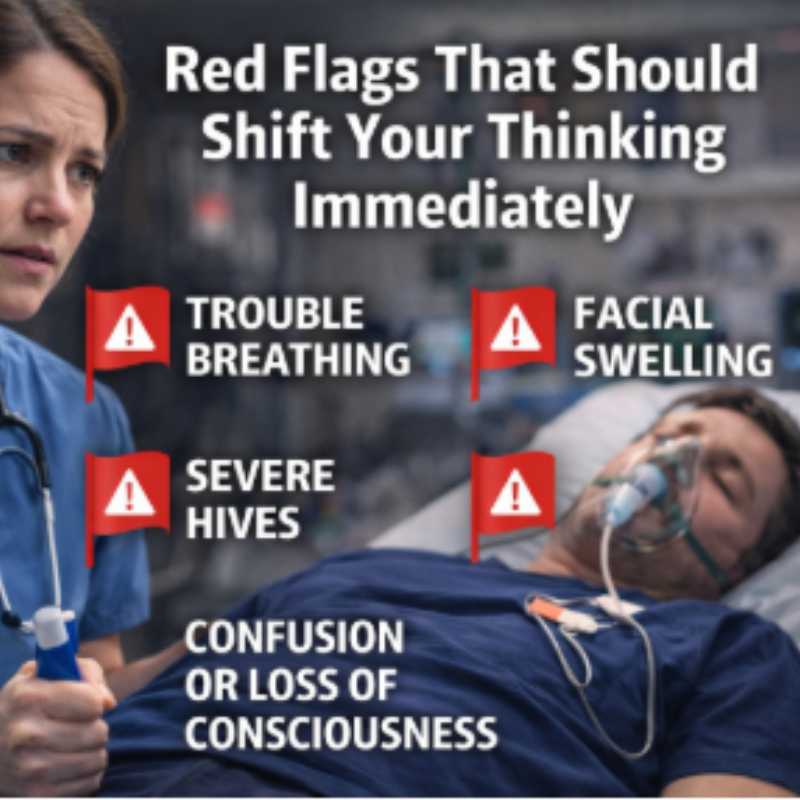
Perhaps the most telling red flag is the speed of progression. A reaction that worsens over minutes, spreads from one system to another, or accelerates after exposure is behaving like anaphylaxis, not a localized allergy.
A simple way to hold this in your mind at the bedside: when multiple systems are involved, think systemic. When the airway or blood pressure is affected, think emergency.
Why the Distinction Matters
The difference between an allergic reaction and anaphylaxis determines how urgently we act. Current guidelines are consistent on the management of anaphylaxis: immediate intramuscular epinephrine, activation of the emergency response, continuous airway and hemodynamic monitoring, and awareness that symptoms can recur.
Epinephrine is given intramuscularly in the mid-anterolateral thigh, which allows faster absorption than other injection sites. The typical dose is 0.01 mg/kg of the 1 mg/mL solution, up to a maximum of 0.5 mg in adults and 0.3 mg in children. It can be repeated every 5 to 15 minutes if symptoms persist or worsen. The CDC’s best practice guidance on managing adverse reactions identifies immediate intramuscular epinephrine as the treatment of choice when respiratory, cardiovascular, or other signs of anaphylaxis are present. There are no absolute contraindications to epinephrine in anaphylaxis.

Timing matters. Delayed epinephrine administration has been associated with worse outcomes, including fatal reactions (Cardona et al., 2020; Shaker et al., 2020). Hesitation is understandable when the picture isn’t completely clear, but in anaphylaxis, the risk of waiting far outweighs the risk of treating.
Positioning matters too. A patient with hypotension should generally lie flat with her legs elevated, while a patient in respiratory distress may need to sit up to breathe. A pregnant patient should be positioned on her left side to reduce compression of the vena cava. Patients in anaphylaxis should not be allowed to stand or sit up suddenly, as a rapid change in position can worsen circulatory collapse.
Nurses also need to be aware of biphasic reactions, in which symptoms return hours after the initial reaction appears to have resolved, without any new exposure to the trigger. A patient who looks well after treatment still needs appropriate observation, and patients and families need clear discharge education about what to watch for and when to seek care.
The Role of Antihistamines and Steroids
One of the most common pitfalls in anaphylaxis management is relying on antihistamines or steroids first. Both can have a place in care, but neither replaces epinephrine.
Antihistamines can relieve itching and hives, but they do not treat airway obstruction or reverse hypotension. Steroids have a slow onset and do not reverse shock. The 2020 anaphylaxis practice parameter update specifically examined the role of these medications and reinforced that they are adjuncts, not substitutes. They may be given after epinephrine, but never instead of it.
This point is worth emphasizing because a patient whose hives improve after an antihistamine may appear to be improving while airway swelling or hypotension continues to progress. Epinephrine remains the first-line therapy for anaphylaxis.
Bottom Line for Clinical Practice
A mild allergic reaction is typically localized, limited to one body system, and free of airway or circulatory compromise. Anaphylaxis is systemic, rapidly evolving, and potentially life-threatening, even in the absence of hives.
Recognizing the difference is not just academic knowledge. It is a bedside skill that protects lives. When a patient’s reaction begins to spread across body systems, or when breathing or blood pressure is affected, the response should shift immediately to emergency management, with intramuscular epinephrine as the first step.
For patient-friendly information you can share during discharge teaching, MedlinePlus offers a clear overview of anaphylaxis from the National Library of Medicine.
If you want more continuing education that reflects real clinical practice, explore my CE courses at altruisticnursewriter.com/continuing-education.